
THE STRENGTH CARD OF THE TAROT
IS A 15TH CENTURY ARCHETYPE OF THE TAROT STILL VIABLE IN OUR WORLD TODAY?
A COMPARISON OF THE SYMBOLISM OF THE VISCONTI-SFORZA TAROT OF THE 15TH CENTURY VS. THE RIDER-WAITE DECK OF THE 20TH CENTURY
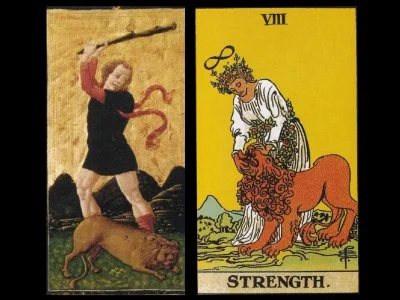
VIII (8) STRENGTH
The Visconti-Sforza tarot card (left) and the Rider-Waite card (right)
Carl Gustave Jung was fascinated by the images of the tarot as representations of innate structures of the psyche and phases that we all pass through in navigating the journey that forms our lives. He saw them as mirrors of psychic conditions. With this in mind, mirrors can be very useful for "reflection".
In choosing a new deck, I was drawn to the Visconti-Sforza deck because many of the cards are housed at the Pierpont-Morgan Library (I LUV NY!). However, upon seeing the STRENGTH card, my initial thoughts were that the Visconti deck might be so old that it lacked the currency today to be an adequate mirror of the modern psychic condition.
The woman of the Rider-Waite card uses power through authority while maintaining loving kindness. In a Kabbalistic reading, this could be more the energy of Chesed (the energy of the diplomat), while the Visconti-Sforza deck seems to lean into the energy of Geburah (the energy of the warrior). Both of these Sephiroth sit in the middle of the Kabbalistic Tree of Life and their energies are meant to be in balance with eachother - i.e. sometimes the application of encouragement (Chesed) is needed, while at other times, discipline (Geburah) is necessary to achieve a goal in a balanced manner.
Initially, it looks as if the figure in the background of the Visconti-Sforza deck is about to club the animal (!) and the closer connection to a hunter-gatherer society, may have made this a little more acceptable in the 15th Century. However, with more observation, the card reveals that the lion's body language is more like that of a mouse crawling away and the young man would be incredibly large in comparison - he towers over the animal. Likewise, a lion in the stance of the Rider deck, would reach shoulder height on an average human, and by comparison, the woman of the Rider deck would be closer to 8 feet tall.
Symbolically, the number 8 as well as the lemniscate above her head are symbolic of her eternal nature and connection to divine, source energy, while the white gown is emblematic of her spiritual growth. The crown on her head and the garland of roses around her waist carry the symbolism of natural passion harmonized through love directing the will - the integration of vital energy. Roses are also believed to carry the highest energetic frequency of the plant world due to their strong physicological effects in terms of their ability to elevate mood, calm stress, and regulate the limbic system.
In the Visconti deck, the man is athletic, a sign that he has prepared for his adventure through discipline of the body. His red sleeves could be read as human desires, while the blue over garment would be symbolic of his governance of these through wisdom and a calm mind. The lion for both cards, can be read as a depiction of the ego and fierce animalistic desires that are not easily controlled. However, both have managed to tame this nature; and both are larger than your average human through their wisdom and authority as eternal beings connected with their higher nature. Their stature (as well as the lemniscate) is a hidden depiction of the Hermetic teachings of the mystery school about anchoring in higher frequency energy through initiation - the teaching is that when we do this and raise our vibration, problems or egoic desires that are low frequency, become much smaller and easier to manage.
The initiatory act alluded to in the cards is central to the lineage of King Salomon and has been handed down for over three thousand years and is still done to this day to accelerate spiritual progression and live a more empowered life.
Find out more about lineage initiation and the path of empowerment - Empower Thyself
Or to find a guide to the mystery school in your area - Guide